

The first time I opened a stock app, I felt stupid.
Words like market cap, PE ratio, bullish, SIP, IPO were flying everywhere.
Everyone else looked confident.
I just nodded… and clicked randomly.
That’s when I realised something important.
Most Indians don’t fear the stock market.
They fear the language of the stock market.
This guide on stock market terms India beginners must know exists so you don’t feel lost, confused, or scared like I did.
No English-heavy explanations.
No finance-class gyaan.
Just real words. Real meaning. Real Indian context.
Let’s break this down—slowly, clearly, and honestly.
Understanding Stock Market Terms in India (Beginner Friendly)
Stock market terms are simply labels used to explain what is happening with money, companies, and shares.
🔗 Think about this:
- You don’t need to become an expert
- You don’t need to memorise everything
- You only need clarity
🔗 Why Terms Feel Confusing
- English finance words
- No real-life examples
- Fear of making mistakes
Once the words become familiar, fear disappears.
Why Stock Market Terms Matter in Indian Reality
In India:
- Salaries are limited
- Inflation is high
- Fixed deposits barely beat inflation
Stock market is no longer optional knowledge.
Mini Story
A school teacher in Coimbatore avoided stocks for 10 years.
Reason?
“I don’t understand these terms.”
Once she learned basics, she started SIPs.
Confidence changed. Fear reduced. Money grew.
Knowledge doesn’t make you rich.
Clarity makes you calm.
Stock Market Terms India – Absolute Basics You Must Know
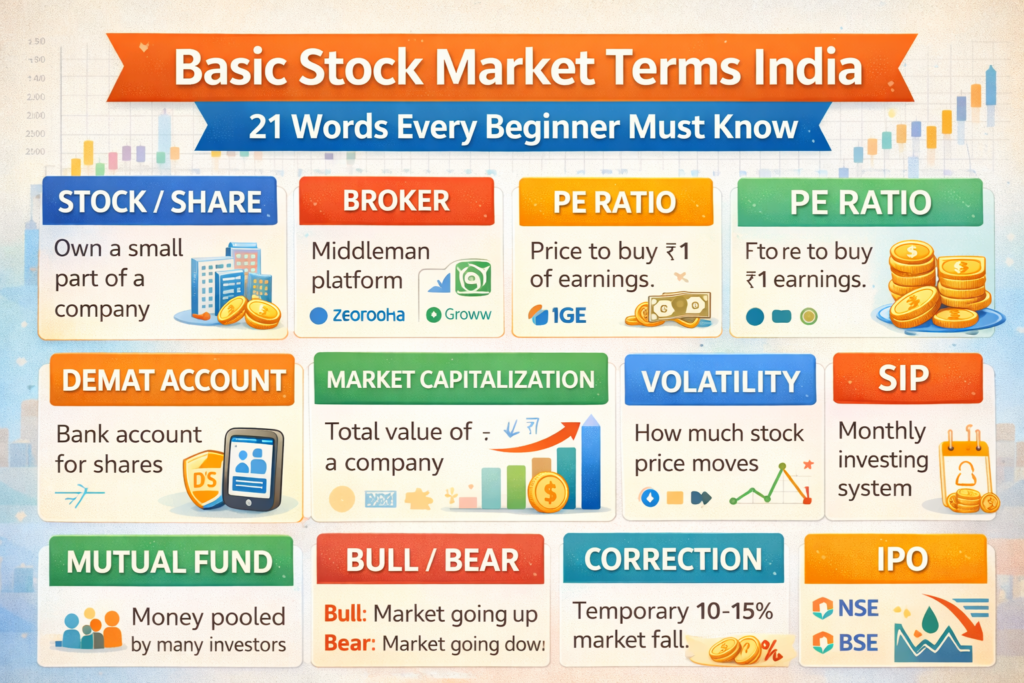
1. Stock / Share
A share means owning a small part of a company.
If you own 1 share of a company, you are a partial owner.
2. Stock Market
A place where shares are bought and sold.
In India:
- NSE
- BSE
Think of it like a weekly market for company ownership.
3. Demat Account
Your digital locker for shares.
Without Demat → No investing.
4. Trading Account
Used to buy and sell shares.
Demat stores.
Trading account transacts.
5. Broker
A middleman platform that connects you to the stock market.
Examples:
- Zerodha
- Groww
- Upstox
Price & Value Related Terms (Very Important)
6. Market Price
Current price at which a share is trading.
7. Market Capitalization (Market Cap)
Total value of a company in the stock market.
| Type | Market Cap |
| Large Cap | ₹20,000 Cr+ |
| Mid Cap | ₹5,000–20,000 Cr |
| Small Cap | Below ₹5,000 Cr |
8. PE Ratio
Price you pay for ₹1 of company earnings.
Lower ≠ always better
Higher ≠ always bad
Context matters.
9. Dividend
Profit shared with shareholders.
Good for:
- Retired people
- Passive income lovers
Risk & Behaviour Terms Indians Must Understand

10. Volatility
How much a stock price moves.
More volatility = more emotional pressure.
11. Bull Market
Market going up.
Optimism everywhere.
12. Bear Market
Market going down.
Fear everywhere.
Smart investors are calm in both.
13. Correction
Temporary market fall (10–15%).
Not a crash.
Not a reason to panic.
Step-by-Step – How Beginners Should Learn Terms
Step 1: Learn 5 Terms a Week
Not 50 in one day.
Step 2: Connect Term to Real Money
“How does this affect my ₹10,000?”
Step 3: Use One App Only
Avoid confusion.
Step 4: Observe Before Investing
Watch market behaviour first.
SIP, Mutual Funds & Long-Term Terms

14. Mutual Fund
Money collected from many investors and invested professionally.
15. SIP (Systematic Investment Plan)
Monthly investing discipline.
₹500/month > ₹0/month.
16. NAV
Price of one mutual fund unit.
Like share price for funds.
17. Expense Ratio
Fee charged by fund house.
Lower = better (generally).
Mistakes Indians Make With Stock Market Terms
- Thinking trading = investing
- Copying others blindly
- Overconfidence after one profit
- Fear after first loss
Pro Secret
Understanding terms reduces emotional decisions.
Comparison – Investing vs Trading (Beginner View)

| Factor | Investing | Trading |
| Time | Long term | Short term |
| Risk | Lower | Higher |
| Stress | Low | High |
| Best For | Beginners | Experts |
Real-Life Indian Stories
Story 1: College Student
Learned basic terms. Started ₹500 SIP.
Now confident, not scared.
Story 2: IT Professional
Stopped trading randomly. Focused on long-term investing.
Story 3: Homemaker
Understood NAV & SIP. Started financial independence journey.
Tools, Apps & Resources

These tools simplify stock market terms India beginners struggle with:
- Groww – Clean UI, beginner friendly
- Zerodha – Education via Varsity
- ET Money – Mutual fund clarity
- Paytm Money – Simple fund investing
Quick Comparison
| App | Best For | Why |
| Groww | Beginners | Easy terms |
| Zerodha | Learners | Free education |
| ET Money | MF investors | Fund analysis |
| Paytm Money | Simple SIP | Minimal UI |
Affiliate Recommendation
When I started, I used Groww because it didn’t make me feel stupid.
Terms were explained. Buttons were clean.
That confidence mattered more than features.
Choose the app that makes learning easy, not fancy.
Final Thoughts
You don’t need to know everything.
You just need to start understanding something.
Stock market terms are not barriers.
They are signboards.
Once you can read them, the road becomes clear.
Start slow.
Stay curious.
Your money journey will thank you.
🔗 Internal & External Linking Suggestions
Internal Links
- How to start investing in India
- SIP vs FD comparison
- Best mutual funds for beginners
- Common stock market mistakes India
External (Authoritative)
FAQs – Stock Market Terms India
What are stock market terms India beginners must know?
Basic words like share, SIP, PE ratio, market cap.
Are stock market terms hard to learn?
No, if explained with examples.
Can I invest without knowing all terms?
Start after learning basics to avoid fear.
How long does it take to understand stock market terms?
2–4 weeks with regular reading.
Which app explains terms best in India?
Groww and Zerodha are beginner friendly
Is English compulsory to learn stock market terms?
No. Understanding matters, not language.
Do professionals still learn new terms?
Yes. Markets evolve constantly.
Nice definition
Thank you.